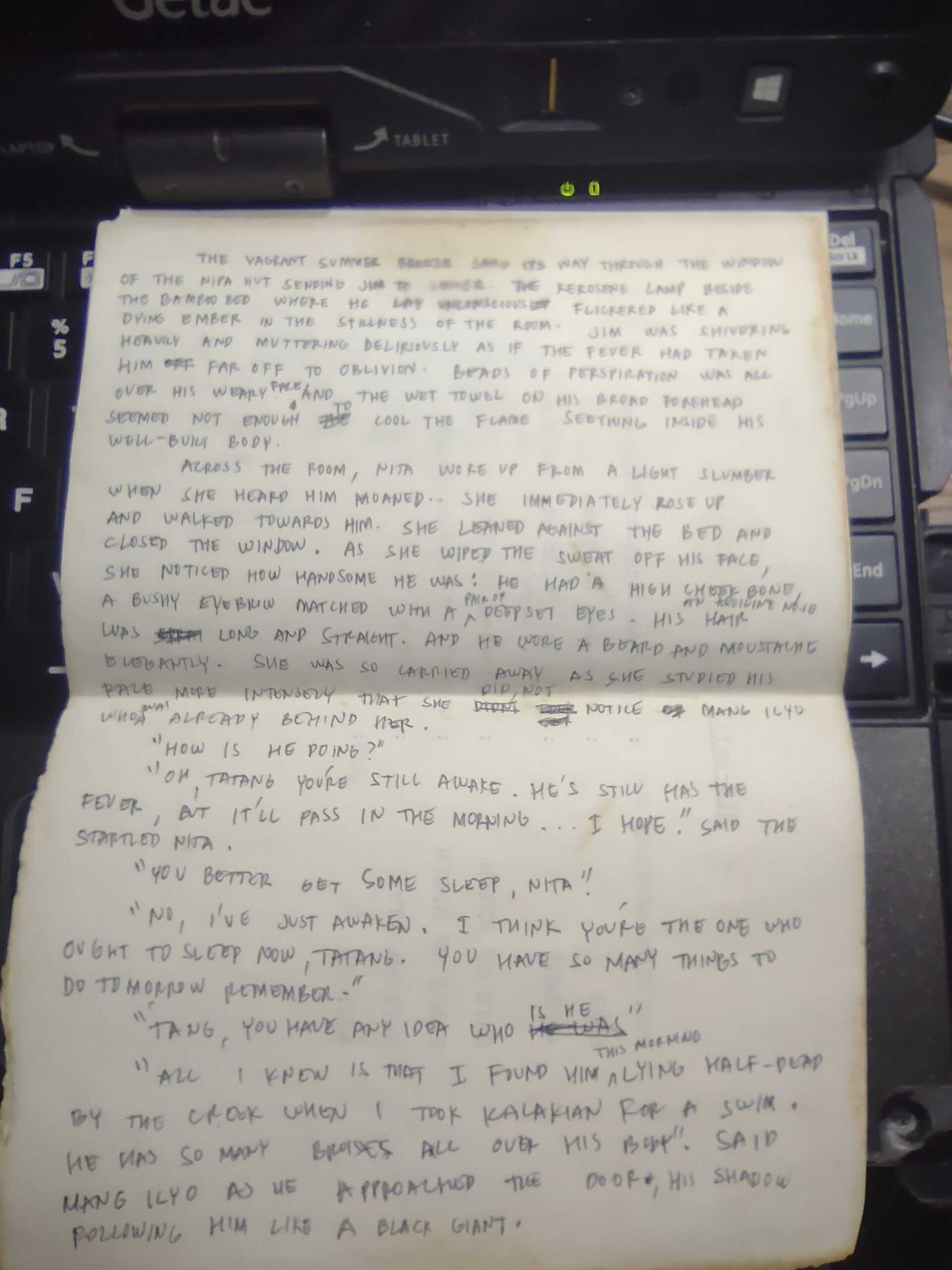
While rummaging through my stack of old books one weekend, I noticed a piece of paper inserted between the pages of the HP15-C scientific calculator manual. It was the first page draft of one of my short story that I wrote back in 1986 during the coup de tat (Edsa revolution), when the classes in Manila were suspended for weeks.
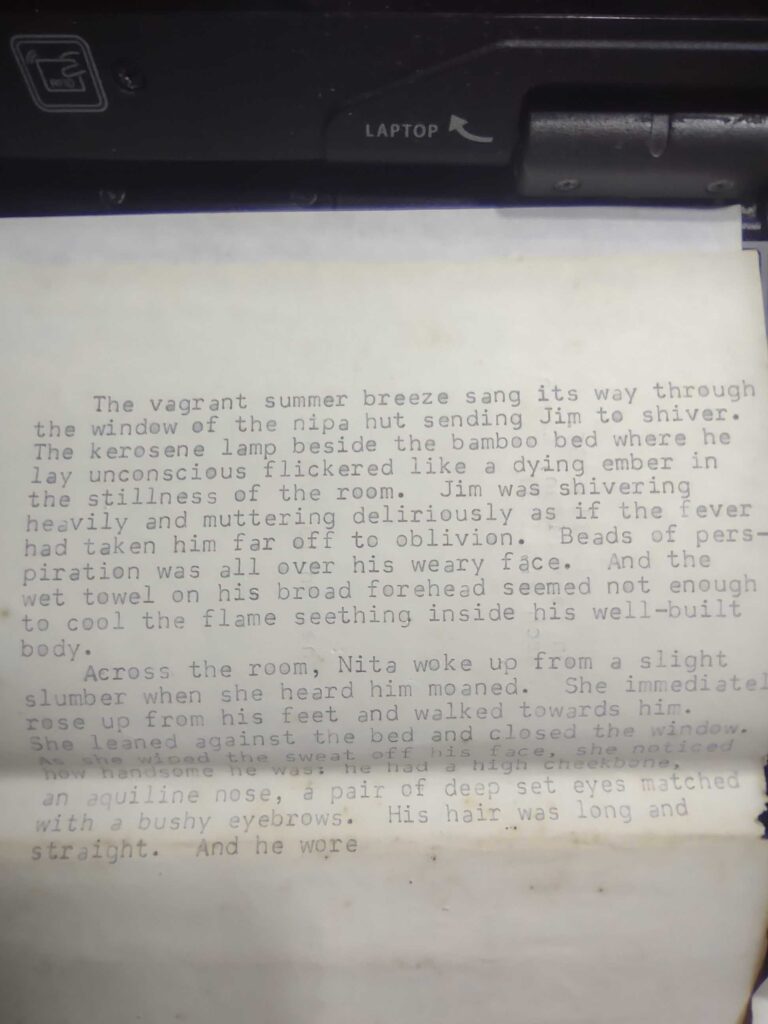
I spent an hour or so to look for the other pages but could only find fragmented type written page of it but still the other pages were missing. I can hardly remember what was the plot about and why I wrote it 4 decades ago.
I decided to ask Claude, an AI model by Anthropic for help. I told the agent all the information it might need: the background, context, places, the year and the possible circumstances. Then finally, I pasted the first page. Please see below an excerpt of our chat session. Claude even liked the task at hand.
Me: I wrote a story about 40 years ago but could only find the beginning page and fragments. If I give you the beginning page, can you try to finish it?
Claude: I’d like that. Paste what you have.
Claude: A few things worth knowing before you do, since a 40-year-old fragment is a particular kind of thing to hand over:
Claude: I’ll match the voice you wrote in, not mine — including whatever’s a bit rough or dated about it, because that’s the texture of the piece. If the fragment ends mid-scene I’ll pick up from that exact line rather than restarting.
Claude: And it helps if you tell me two things alongside it: roughly how long you want the ending to run, and whether you remember where it was going. Even a vague memory — “he was supposed to not make it back” — changes everything. If you’ve genuinely forgotten, that’s fine too; I’ll read the fragment for what it seems to want and tell you what I think it was reaching for before I write it.
The initial result was impressive, but I had to revise and polish as there are some character inconsistencies. I also asked him to correct grammar errors on my original first page.
Hereunder is the finished story.
A Man From Laguna
“People should know they were here. That’s all.”
Begun 1986. Completed 2026.
The vagrant summer breeze sang its way through the window of the nipa hut, sending a shiver through Jim. The kerosene lamp beside the bamboo bed where he lay unconscious flickered like a dying ember in the stillness of the room. Jim was shivering heavily and muttering deliriously, as if the fever had taken him off to oblivion. Beads of perspiration were all over his weary face, and the wet towel on his broad forehead seemed not enough to cool the flame seething inside his well-built body.
Across the room, Nita woke from a light slumber when she heard him moan. She immediately rose and walked towards him. She leaned against the bed and closed the window. As she wiped the sweat off his face, she noticed how handsome he was: he had high cheekbones, an aquiline nose, and bushy eyebrows matched with deep-set eyes. His hair was long and straight. And he wore a beard and moustache elegantly. She was so carried away as she studied his face more intensely that she did not notice Mang Ilyo, who was already behind her.
“How is he doing?”
“Oh, Tatang, you’re still awake. He still has the fever, but it will pass in the morning… I hope,” said the startled Nita.
“You’d better get some sleep, Nita.”
“No, I’ve just woken up. I think you’re the one who ought to sleep now, Tatang. You have many things to do tomorrow, remember?”
“Tang, do you have any idea who he is?”
“All I know is that I found him this morning lying half-dead by the creek when I took Kalakian, for a swim. He has so many bruises all over his body,” said Mang Ilyo as he approached the door, his shadow following him like a black giant.
“Maybe he fell,” Nita said. “The rocks by the crossing—”
“The creek is knee-deep at the crossing, anak.” He said it without any edge, which was worse. “A man does not get those from water.”
He lowered himself onto the bench by the door and began, in the dark, to make a cigarette — the rustle of the dried leaf, the scrape of a match. The flame lit his face briefly. It was not a face that was giving anything away.
“There is a mark on his back,” he said, “the width of a rifle butt. I have seen that mark before. I saw a great many of them when I was a younger man than he is.” He drew on the cigarette. “So. Now you know as much as your father knows, and it is already too much.”
Nita looked down at the stranger. His lips were moving again, forming words that had no sound in them.
“Tomorrow, if anyone asks, he is your cousin from Laguna. He came down for the harvest and took the fever on the road. That is all. You have told this to no one, because there has been nothing to tell.”
“Tatang—”
“Sleep, Nita.”
He went out. She heard the ladder creak under him, and then the yard was quiet except for the dogs somewhere down the barrio, and the first cocks, who always began too early and were always wrong.
The fever broke a little before dawn.
She knew it before she touched him, because the muttering had stopped and his breathing had gone long and even, the way a carabao’s breathing goes when it has finally been let into the water. When she laid her hand on his forehead it was cool and damp, and his eyes opened.
He looked at the nipa above him for a long moment, taking it in thatch by thatch.
“What day is it,” he said.
His Tagalog had the flat, clipped sound of the city in it, the ends of the words bitten off.
“Wednesday. Tatang brought you in yesterday morning.”
He shut his eyes. Then, carefully, as though the answer would cost him something: “Was there anyone else? Did he find anyone else by the creek?”
“No. Only you.”
He turned his face to the wall, and he did not speak again that morning.
When Mang Ilyo came up from the field at noon he asked the stranger his name. The young man was quiet so long that the silence became its own answer, and the old man, who had lived sixty-one years and understood such silences, did not ask a second time. But in the night of his fever he had called out one name, over and over, calling it the way a man calls across water — Jim, Jim — and so Nita had begun to think of him by it, and then to say it, and he never once corrected her.
So he was Jim.
The bruises went from black to green to a bad yellow, and then they went away, and by the time they had gone he was mending the fence along the eastern side where the pigs had been getting through. He reset the two corner posts that the last typhoon had loosened, and he did it properly, wedging them with stone. He got the radio to speak again after two years of silence, though what it said was mostly static and a woman advertising soap.
He was not a farmer. Nita saw that in the first week. He worked hard and without complaint, but his hands blistered like a child’s, and he held the bolo the way a man holds something he respects but has not been introduced to. His hands were long-fingered, and the nails stayed clean even when the rest of him did not.
At night he wrote.
She had found the notebook in the sari-sari store in the poblacion, a thin one with pale green lines, and she bought it with her own money and left it on the sill without saying anything. In the morning it was gone from the sill, and that evening he was bent over it by the lamp.
“What do you write?” she asked him once.
He did not look up. “Names.”
“Whose?”
He turned a page. The lamp moved on his face — the high cheekbone, the deep-set eye — and she thought that he looked, just then, much older than he could possibly be.
“People should know they were here,” he said. “That’s all. That they were here, and what their names were.”
The jeep came on a Thursday in the last week of the harvest.
They heard it from far off, grinding up the barrio road in low gear, and by the time it reached the yard Mang Ilyo was standing at the top of his ladder with his salakot in his hand and his face arranged into the pleasant, slightly stupid expression of an old man who has never had a thought in his life.
There were four of them. The sergeant did the talking.
They were looking, he said, for a man. Young. Injured, most likely — badly. Come down out of the hills toward the creek some weeks back. The barrio captain had been most cooperative. And who, he asked, was this?
Jim was standing at the corner of the house with the bolo in his hand and a quarter of the fence still unmended behind him.
“My nephew,” said Mang Ilyo. “From Laguna. He came for the harvest and has given me nothing but trouble — took the fever on the road and lay there two weeks eating my rice.”
The sergeant looked at Jim. Jim looked back with the mild, faintly bored expression of a young man who has been made to work in the sun and is not enjoying it. Nita, at the window, found that she had stopped breathing.
“Laguna,” said the sergeant.
“Opo,” said Jim.
The sergeant’s eyes went down to the hands holding the bolo. They stayed there one moment, no more, and Nita felt the whole of her life go thin, like a thread drawn out.
Then the sergeant said that they would be needing two chickens, for the men, it being a long road back. And Mang Ilyo said of course, of course, take three, and called up to Nita to catch them. She went down into the yard on legs that did not belong to her and chased chickens while four men watched, and one of them laughed at her.
The jeep went back down the road. The dust hung in the air a long while after, the way it does in the dry months.
Nobody said anything for the rest of the afternoon.
He came to her that night at the window.
“I’m going before light,” he said. “It’s better if your father doesn’t see me go. Then he won’t have to tell a lie about it afterward.”
“Where?”
“North. There are people.”
“And if there are no people?”
He didn’t answer that.
She had known it was coming since the jeep, and she had thought she would be able to hold her face still, and she found that she could not. He saw it, and looked away, out at the dark where the fields were.
“My name isn’t Jim,” he said.
“I know.”
“He was—” He stopped, and started again, differently. “There were nine of us. From the university, most of us. We were going to be teachers, and one of us a dentist, God knows why. Jim was the one who could make you laugh at four in the morning when everything was wet and nothing was funny.” He said it in an ordinary voice, the way a man reads out the price of rice. “When they came down on us he pushed me into the creek and went the other way along the bank, shouting, so the shouting is what they followed. So your father found me in the morning and not him. That’s the whole of it. That’s all it is.”
The lamp guttered. Neither of them moved to fix it.
“I let you call me by his name,” he said, “because it was the only way I could stand to hear it out loud.”
“Then tell me yours.”
He told her. It was a plain name, a name like anyone’s, and she understood as he said it that he had not spoken it in five months, and that he was handing it to her the way a man hands over the last thing he owns.
He gave her the notebook too.
“Not to read,” he said. “To keep. Under the floor, or in the rice — somewhere your father won’t find it and be frightened of it. If I come back, I’ll ask you for it.” He almost smiled. “If I don’t, it will still be true that they were here, and what their names were. That has to be worth something.”
“And when do I take it out?”
“When it’s safe.”
“How will I know?”
He looked at her a long moment. “You’ll know. It won’t be soon.”
He went before the light, as he said he would. She did not hear him go — that was his kindness, or his training, and she never did decide which. She only saw, from the window, the shape of him crossing the yard toward the creek, and his shadow going before him in the setting moon, stretched out long across the stubble like a giant.
The notebook went into a tin, and the tin under the third board from the wall where her mother had once kept the money for the land taxes, and the board went back down over it, and the years went over the board.
She was seventeen that summer. She turned eighteen, and then a good deal more than eighteen. The road to the poblacion was paved. Mang Ilyo was buried at the end of a long wet season with a great many people in attendance, and the radio he had fixed was finally thrown out. No one ever came back to ask after a man from Laguna.
But in the hot months, when the nights would not let anybody sleep, she would lie on the bamboo bed where he had lain and listen to the vagrant summer breeze coming up from the creek, moving through the bamboo, finding the house, finding the window.
The first night, she remembered, she had risen and closed it against the draught, so that he would not take a chill.
She never closed it again.